
Engineering & Automation
China's First TBM Export to Sri Lanka: Engineering a Micro Shield for Hard Rock and Tight Curves
Introduction
On 1 February, a 3.7-metre-diameter earth pressure balance (EPB) tunnel boring machine (TBM) completed factory acceptance testing at the Changsha facility of China Railway Construction Heavy Industry (CRCHI) in Hunan Province, China. The unit is the first Chinese-built TBM exported to Sri Lanka and is scheduled for shipment to Colombo after the Chinese New Year holiday, with site launch planned for April 2024.
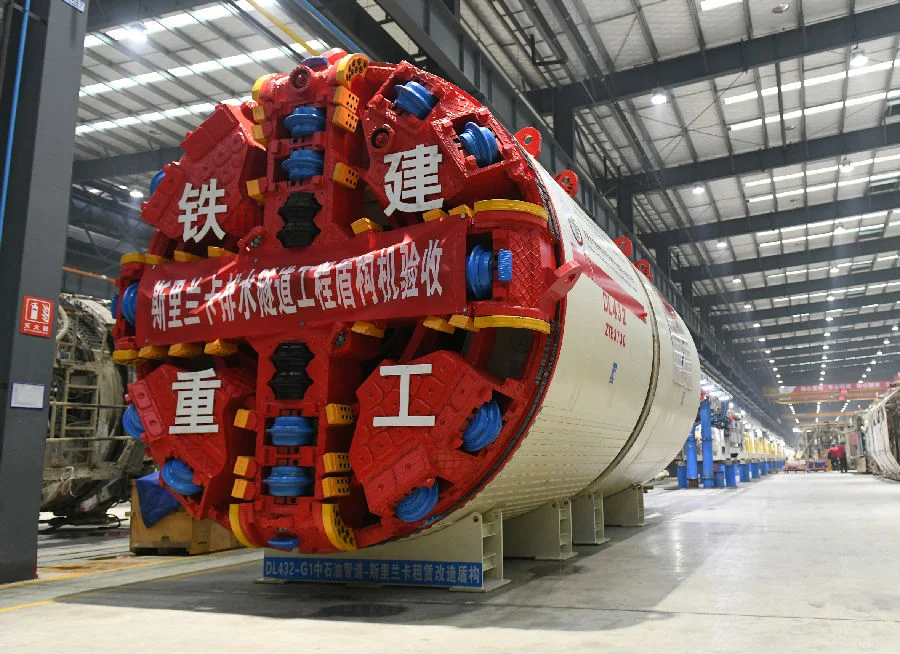
The machine will be used on the New Mutwal and Torrington drainage project, a flood-mitigation scheme commissioned by the Sri Lankan government to relieve pressure on Colombo's ageing stormwater network during the monsoon season. The construction contract is held by China Petroleum Pipeline Engineering, while CRCHI supplies the TBM.
For tunnelling engineers and equipment buyers, the project is notable less for its size than for the combination of constraints it imposes: a small bore, extremely hard rock, and an unusually tight horizontal alignment. This article examines the technical requirements of the drive, how micro TBMs differ from conventional machines, and what the case reveals about equipment selection for urban drainage tunnels.
Project Context: Drainage Tunnels in Coastal Colombo
Sri Lanka is an island nation in the Indian Ocean and a long-standing node on maritime trade routes. Its interior is dominated by highland terrain, while the coastal belt around Colombo is low-lying. During the southwest monsoon, rainwater descends from the central hills toward the coast, and the capital's legacy drainage system has historically struggled to handle peak flows.
The New Mutwal and Torrington drainage project was tendered internationally to address this capacity shortfall. According to the project information released at the acceptance ceremony, the tunnel alignment passes through predominantly gneiss and other very hard rock formations, with rock strength reaching 150 MPa. The alignment also includes sections with a minimum horizontal curve radius of just 80 m.
These two parameters—high compressive strength and tight curvature—are the defining design drivers for the machine. In conventional metro or utility tunnels, curve radii of 250 m or more are common, and hard-rock sections are frequently addressed with different machine types or with drill-and-blast methods. Combining hard rock with an 80 m radius in a 3.7 m bore is what makes this project technically distinctive.
Why a Micro TBM, Not a Conventional Machine
The diameter of a TBM is not simply a scaling factor. As bore size decreases, the ratio of machine structure and component volume to available internal space changes sharply, and the layout problem becomes the dominant engineering challenge.
At 3.7 m, the machine described here is the smallest-diameter EPB TBM manufactured in China to date, according to the project's chief designer and project manager, Zhang Ruilin. The complete machine train is approximately 120 m long and integrates mechanical, electrical, and hydraulic systems, with the same functional scope as larger machines: excavation, support, and muck removal.
The key differences lie in packaging and component selection:
Custom components. Most major components had to be customised to fit the restricted internal envelope, rather than selected from standard large-TBM catalogues.
Segment handling. On large TBMs, the segment erector is housed within the shield and there is ample room for lifting and rotation. In a 3.7 m bore, a travelling, lifting feed device was configured to deliver segments to the erector, allowing rapid transport in a confined space.
Operator environment. Despite the limited space, the machine includes a car-style control cabin and a man lock (compressed-air chamber) to support safe cutter replacement.
The practical implication for buyers is that micro TBMs should be evaluated as bespoke engineering projects rather than off-the-shelf products. Delivery time, spares strategy, and the supplier's ability to design around a fixed envelope deserve as much attention as nominal performance figures.
Cutterhead and Drive Design for 150 MPa Rock
A rock strength of 150 MPa is high for EPB tunnelling, which is more commonly applied in soils and mixed ground. At this strength, cutter wear, impact loading, and drive torque become critical.
The measures described for this machine include:
Wear protection. The cutterhead and screw conveyor were given special wear-resistant protection for hard-rock duty.
Cutter configuration. Reinforced and impact-resistant cutters were fitted, with gauge cutters equipped with an overcut device to maintain gauge and assist steering in hard ground.
Drive train. The main drive uses multiple high-torque hydraulic motors, selected for impact resistance rather than solely for maximum torque density.
It is worth distinguishing between verified project information and general industry practice here. The specific configuration above is drawn from the project's own acceptance announcement. The broader principle—that hard-rock EPB tunnelling requires higher cutter loads, more frequent inspection, and conservative drive sizing—is well established in tunnelling practice, but actual performance will only be confirmed once excavation begins.
Articulation and the 80 m Curve Radius
Curving a shield machine is fundamentally a geometry problem. The shield is a rigid steel cylinder; to follow a tight radius, the machine must be articulated so that the front and rear sections can deviate relative to each other.
For this project, the shield body was designed in two sections—a front shield and a tail shield—joined by a spherical hinge. Four sets of eight active articulation cylinders control the relative angle, allowing the machine to negotiate the 80 m radius. The belt conveyor was also fitted with an adjustment device to accommodate the curve.
Three practical points follow from this design choice:
Thrust and steering loads concentrate at the articulation joint. Maintenance planning should treat the hinge, cylinders, and seals as high-wear items.
Curve negotiation reduces effective thrust efficiency. Advance rates on tight curves are typically lower than on straight drives, and this should be reflected in programme assumptions.
Segment build tolerance tightens. Small-radius curves increase the risk of segment misalignment and require closer survey control.
What This Means for Equipment Selection
For engineers specifying TBMs for urban drainage, water transfer, or utility tunnels, several selection factors emerge from this case.
Define the Ground and Geometry First
Machine type should follow from the geological profile and alignment, not from available catalogue sizes. Where hard rock and tight curves coincide, the machine must satisfy both conditions simultaneously, which usually means a custom shield configuration and a robust articulation system.
Assess the Supplier's Customisation Capability
Micro TBMs involve a high proportion of custom parts. Buyers should examine the supplier's design capability for confined layouts, its track record on comparable diameters, and its approach to spares for non-standard components.
Plan for Logistics and Reassembly
A 120 m machine train must be dismantled, packed, shipped, and reassembled on site. For island or remote sites, port access, crane capacity, and site assembly space should be confirmed early. In this project, the machine was scheduled for dismantling and shipment after acceptance, with launch planned for April.
Budget for the Full Lifecycle
Cutter consumption in abrasive hard rock, hydraulic component wear, and the labour intensity of working in a confined shield are all cost drivers that do not appear in the purchase price. Total cost of ownership analysis should include cutter changes, man-lock operations, and the productivity penalty of tight curves.
Regional and Trade Perspective
The export is described as the first Chinese TBM supplied to Sri Lanka. It reflects a broader pattern in which Chinese manufacturers have expanded from domestic metro construction into international markets for water, drainage, and utility tunnels. For importing countries, the relevant considerations are after-sales support distance, spare-parts lead times, and the availability of trained operators—factors that matter more for a single bespoke machine than for a fleet purchase.
For Sri Lanka, the project addresses a specific infrastructure need: improving stormwater discharge capacity in the capital. The technical success of the drive will depend on how the machine performs in the stated gneiss conditions and on the construction contractor's operating and maintenance discipline.
Note: The performance figures and design details cited in this article are based on information released at the factory acceptance ceremony. Actual tunnelling performance, cutter consumption, and advance rates will only be established during excavation and should not be assumed from design specifications.
Sources and References
Frequently Asked Questions
What is an earth pressure balance TBM?
An EPB TBM uses the excavated material itself, conditioned with foam or other additives, to support the tunnel face. A screw conveyor controls the rate at which muck is removed, maintaining pressure balance. EPB machines are widely used in soft ground and mixed conditions, and can be adapted for hard rock with appropriate cutter and drive design.
Why is a 3.7 m diameter TBM harder to design than a larger one?
Internal space shrinks faster than the bore diameter because structures, drives, and services occupy a relatively larger share of the cross-section. Components must be miniaturised or customised, and the layout of the segment erector, control cabin, and man lock becomes a major design constraint.
What does an 80 m curve radius mean for tunnelling?
It is a tight horizontal curve for shield tunnelling, where 250 m is a more typical minimum. It requires an articulated shield, careful thrust control, and closer survey and segment build tolerances. Advance rates are generally lower than on straight alignments.
What rock strength can an EPB TBM handle?
There is no universal limit; machine capability depends on cutter design, drive torque, thrust, and wear protection. Very hard rock increases cutter consumption and reduces advance rates, and in some conditions alternative methods may be more economical. Project-specific assessment is essential.
- Robotic Cutter Changing for TBMs: Automating Disc Replacement in Large-Diameter Tunneling
- Mixed-Face Tunnelling in Clay, Silt and Sand-Gravel: Engineering Lessons from a 12.49 m EPB TBM
- Inside the 14,000-Tonne Ring-Rail Crane: How Ultra-Heavy Lifting Is Changing Nuclear Construction
- Engineering Challenges of Exporting a Micro TBM to Sri Lanka: Hard Rock and Tight Curves