
New Products & Technology
World's Largest Hydropower Pressure Relief Valve Completed for Pakistan's Tarbela 5th Extension
Introduction
A pressure relief valve rarely attracts attention during normal hydropower operation, yet it is one of the decisive safety devices in a high-head water conveyance system. In early 2026, Harbin Electric Machinery Company (HEC), part of Harbin Electric Corporation, completed assembly testing of what it describes as the world's largest hydropower pressure relief valve, manufactured for the Tarbela 5th Extension hydropower project in Pakistan. The valve has a nominal diameter of 3.5 m, stands close to 5 m tall and weighs 92 tonnes.
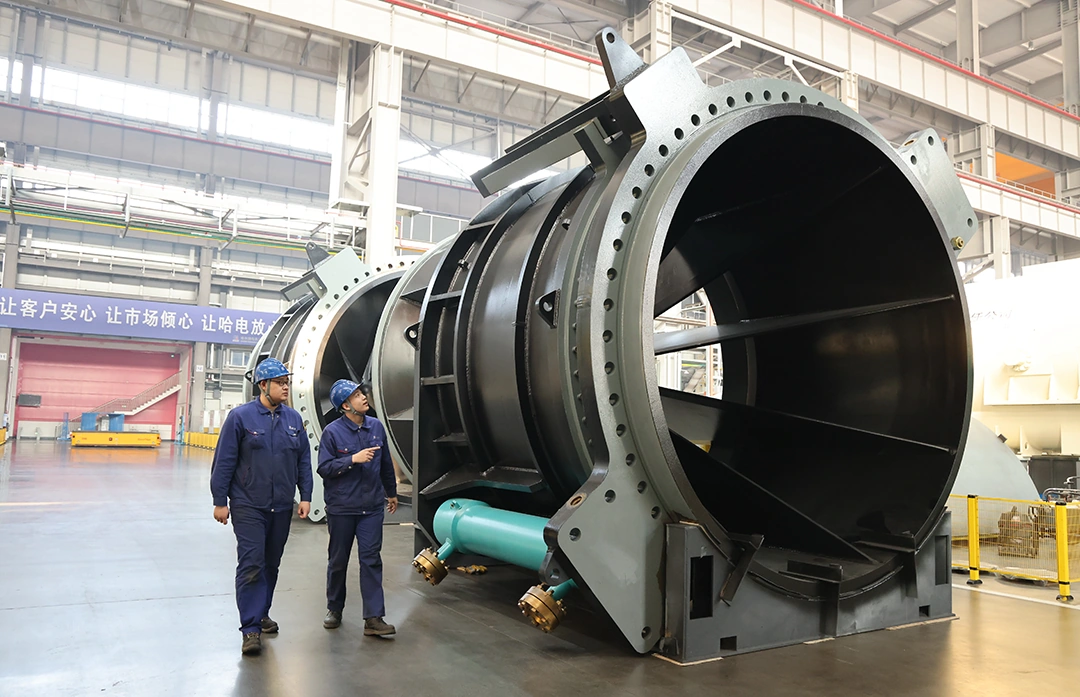
For engineers, procurement teams and plant operators working on large hydro schemes, the announcement is more than a size record. It highlights how the design of pressure protection equipment is shaped by extreme operating conditions, by the need to extend an existing station while it remains in service, and by the manufacturing challenges of very large thin-wall components. This article explains the function of a hydropower pressure relief valve, examines the technical features reported for the Tarbela unit, and discusses what such developments mean for equipment selection and project planning.
Project Context: Expanding Tarbela While It Operates
The Tarbela hydropower station is described in the source material as Pakistan's largest and most important power supply base, generating about one third of the country's electricity. The 5th Extension is a China–Pakistan energy cooperation project, and HEC is supplying all three 470 MW Francis turbine-generator units for it.
The project uses four pressure relief valves: one manifold relief valve and three unit-specific valves, one for each turbine-generator set. According to the source, all four valves passed machining, manufacturing and assembly testing on the first attempt. That detail matters in heavy hydro equipment, where a large fabricated valve body with long-stroke internal movement can accumulate dimensional deviation across many processing steps.
A defining constraint of the 5th Extension is that it is being built at a station that continues to operate. New water conveyance and generating equipment must be integrated into an existing hydraulic system without compromising the availability of the operating plant. The source states that the valve design was adapted to this "expansion under operating conditions" scenario, which is a project-specific requirement rather than a standard design case.
What a Pressure Relief Valve Does in a Hydropower Plant
In a hydropower scheme, water travels from the intake through a headrace tunnel and penstock to the turbine. When the turbine suddenly loses load, the guide vanes close quickly to limit runaway speed. The resulting deceleration of the water column converts kinetic energy into a pressure surge that propagates upstream. This transient can stress the penstock, the spiral casing and the turbine, and in severe cases can damage the water conveyance system.
A pressure relief valve provides a controlled escape path. When system pressure exceeds a set threshold, the valve opens and discharges water to atmosphere or to a downstream outlet, limiting the peak pressure until the transient subsides. The source reports that the Tarbela valves are designed to open fully within 8 seconds and to hold system pressure within a safe range. The same source identifies the protected assets as the headrace tunnel, penstock, spiral casing and turbine.
The reported design pressure is 1.35 MPa, which the source equates to a 135 m water column acting on each square centimetre. This is a static reference value used to describe the design envelope; actual transient pressures during a load rejection depend on the surge analysis of the specific scheme, including tunnel length, flow velocity, valve capacity and closing schedule.
Fixed-Cone Design and the Reported Technical Features
The Tarbela valves are described as fixed-cone (cone) type relief valves. In this configuration, a movable sleeve or cone is driven along the valve axis to open an annular flow passage. The water jet is directed outward and downward, and the geometry of the cone and the discharge path influences the jet trajectory and the dissipation of energy.
The source reports several design and manufacturing points without providing a full specification, so they should be read as manufacturer-stated project features:
Nominal diameter of 3.5 m, described as a world record for a hydropower pressure relief valve.
Design pressure of 1.35 MPa, intended for high-head operating conditions.
Optimised structure, volume and jet trajectory, described as matched to the expansion project's operating scenario.
Long-stroke, high-precision assembly, addressing stable movement of the valve body under extreme conditions.
Large thin-wall component control, referring to manufacturing measures for dimensional stability.
The source does not publish details such as the valve's discharge coefficient, actuation mechanism, control logic, materials of construction or fatigue assessment. Readers evaluating comparable equipment should request these data directly from suppliers rather than infer them from the record-size claim.
Manufacturing Challenges of Very Large Relief Valves
Scaling a relief valve from a typical diameter to 3.5 m changes the engineering problem. The valve body becomes a large thin-wall fabrication, and the moving component must travel a long stroke while maintaining alignment and sealing. Common industry challenges in this size class include:
Weld distortion and dimensional drift during fabrication of large circular sections.
Machining and metrology of sealing surfaces whose roundness and flatness must be held across a large diameter.
Guiding and alignment of the moving sleeve over a long stroke, where small angular errors can cause binding or uneven sealing pressure.
Structural stiffness under unbalanced hydraulic forces during opening and closing.
Transport and site assembly, since a 92-tonne, nearly 5 m tall valve must be moved to a remote site and installed with limited tolerance.
HEC states that it organised a dedicated research team and followed a problem-oriented approach covering theory, process innovation and test verification. This describes a general development methodology rather than a verified set of proprietary processes; the specific welding, machining or heat-treatment methods used are not disclosed in the source.
Selection and Specification Considerations for Buyers
For owners and EPC contractors specifying pressure relief valves for large or high-head hydropower projects, the Tarbela example suggests several practical checks. These are general engineering considerations, not claims about the Tarbela equipment beyond what the source states.
Hydraulic Transient Study First
Valve capacity, opening time and closing behaviour should be derived from a surge analysis of the complete water conveyance system. A valve that opens too slowly may not limit peak pressure; one that closes too abruptly can create a secondary surge. The 8-second full-opening figure reported for Tarbela should be treated as a project-specific design value.
Operating Scenario and Interface Conditions
Projects built alongside an operating station need valves and controls that can be commissioned without disturbing existing units. Interface loads, access for maintenance and isolation provisions deserve early attention in the layout.
Verification and Testing
Factory assembly testing, dimensional inspection and, where feasible, functional testing of the actuation system provide evidence of manufacturing quality. Buyers should agree on inspection hold points, test procedures and acceptance criteria before fabrication begins.
Documentation to Request
A complete technical offer should include design pressure and flow capacity, materials and welding specifications, actuator type and response time, sealing arrangement, structural calculations, quality records and a maintenance plan. Claims of record size or international leadership should be supported by verifiable test data.
Industry Implications
The Tarbela valve illustrates a broader trend in hydropower equipment: as projects add capacity at existing sites and move toward higher heads, pressure protection devices grow in size and complexity. This places greater demands on fabrication yards, testing facilities and transport logistics, and it increases the importance of early hydraulic transient analysis in project development.
For international readers, the announcement is best understood as a manufacturer-reported milestone on a specific project. It demonstrates capability in large valve manufacturing, but it does not by itself establish comparative performance against other suppliers. Procurement decisions should rest on project-specific engineering analysis, verified test data and commercial evaluation.
Sources and References
Frequently Asked Questions
What is the difference between a pressure relief valve and a turbine inlet valve?
A turbine inlet valve, often a spherical or butterfly valve, isolates the turbine for maintenance or emergency shutdown. A pressure relief valve protects the water conveyance system from overpressure during load rejection by discharging water. They serve different functions and are usually specified together in high-head schemes.
Why is a fixed-cone design used for large relief valves?
A fixed-cone design uses an annular opening and a shaped discharge path to control the water jet. This arrangement can provide a large flow area within a compact body and helps manage jet trajectory and energy dissipation. Suitability still depends on the specific head, flow and layout of each project.
Does a larger nominal diameter always mean better performance?
No. Valve size must match the required discharge capacity and the transient behaviour of the system. An oversized valve may be unnecessary and can complicate layout and cost, while an undersized valve may fail to limit peak pressure. Selection should follow surge analysis and agreed design criteria.
What should be verified before accepting a large relief valve?
Buyers should verify dimensional inspection records, material certificates, welding and non-destructive testing reports, assembly test results, actuator function and response time, and compliance with the agreed technical specification. Site installation and commissioning checks should also be planned in advance.

- Chitian Launches 176-Tonne Battery-Electric Rigid Mining Truck
- World's Largest Hydropower Pressure Relief Valve Completed for Pakistan's Tarbela Project
- 5,000-Tonne C-Frame Press Brake Completed in Hubei: Engineering the Frame and Springback Challenge
- China's First 600 MW-Class CAES Expander Completes Integration Testing